

Contents
What AI can and can't do
AI writes text, summarizes, classifies, answers questions and finds patterns in large amounts of data. But it doesn't know your business, it doesn't guarantee accuracy on its own, and it can't take responsibility.
The best results come when AI provides drafts and speed and people provide decisions and control.
Customer communication: a fast, consistent first reply
Customers expect an answer right away. A question that arrives after hours often means a lost customer.
- Q&A assistant on your website: Answers common questions such as delivery times, opening hours and price ranges using the information on your website.
- Message drafts: Suggests reply drafts for questions that come in by WhatsApp and email. You check them and send.
- Routing to the right person: Forwards each request to the right person based on its topic.
Content and marketing
Product descriptions, blog drafts, social media posts and ad variations can be prepared with AI in minutes. But every text must be reviewed before it goes live: wrong information, exaggerated promises or language that doesn't fit your brand can cost you more than the time it saved.
The same rule applies to images: AI images give you ideas quickly, but they must not misrepresent your real product.
Sales, quotes and data analysis
- Preparing quotes: Turning customer needs into a well-organized quote draft.
- Meeting and call summaries: Recording what was discussed as bullet points and listing the next steps.
- Review and feedback analysis: Finding the most frequent complaints and praise across hundreds of customer reviews.
- Sales data: Summarizing which products stood out in which period.
Is AI recommending you to your customers?
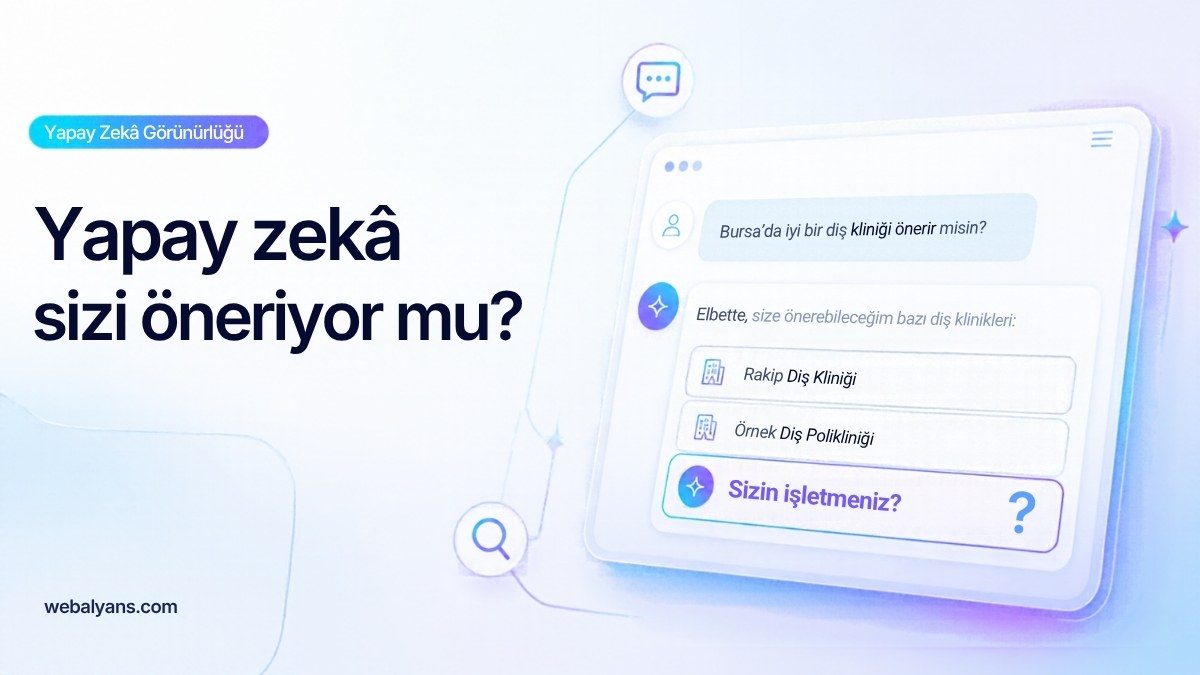
AI also has an effect you don't see: your customers now ask AI assistants "what's the best …?" Even if you don't use AI yourself, AI is talking about your business, or not mentioning it at all.
That's why one of the first steps for any business is to see whether AI recommends it. An AI visibility check asks AI the questions your customers ask and shows which competitors are recommended instead of you. For the details, read: What Is AI Visibility?
Risks: data privacy, accuracy and brand voice
- Personal data: Before sending customer information to AI services, check it against data protection law (such as KVKK in Türkiye or GDPR in the EU). Where possible, remove personal data first.
- Accuracy: AI can sound confident and still be wrong. Always check details like prices, timelines and warranties against the source.
- Brand voice: If every text has the same "AI tone", your brand starts to sound ordinary. Keep your own voice.
Where to start: a 3-step path
- Find the repetitive work: Pick a task with clear rules that takes the most time each week (FAQs, product descriptions, reports).
- Test small: Try it on a single process, with human review, for two to four weeks. Note the time saved and the error rate.
- Build in what works: Integrate the successful use into your website, forms and workflows.
How can AI fit into your business?
First, find out whether AI recommends you to your customers. Then let's plan together the uses that fit your website and processes.
 AI
 E-commerce
 Mobile Apps