
Contents
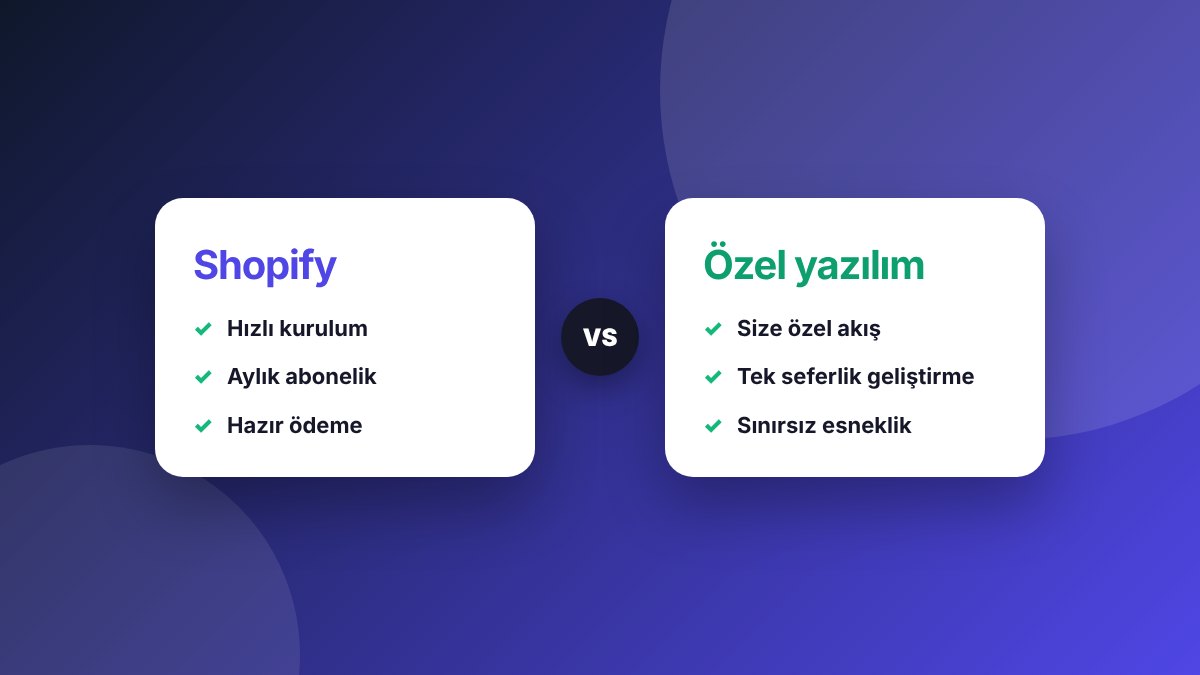
The upside of ready-made platforms like Shopify
Setup is fast, payments and security come built in, and there are no servers or updates to worry about. For businesses that are just starting out or opening a standard store, it is often the lowest-risk path.
- Quick launch
- Ready-made payments, shipping and an app (plugin) ecosystem
- Low technical maintenance
The limits of a ready-made platform
The monthly subscription and some app fees are an ongoing cost. When you need very specific workflows, different pricing rules or deep integration with systems such as an ERP, you may run into the platform's limits.
 -17%

 -10%







The upside of custom software
You can build workflows that match your business exactly. Everything is under your control, with no platform limits. This pays off for large catalogs, dealer systems or sales that need custom calculations.
You can build workflows that match your business exactly. Everything is under your control, with no platform limits.
- Workflows and an admin panel built entirely for you
- Independence from a third-party platform
- Freedom to build custom integrations
The downside of custom software
The upfront investment and development time are higher. Servers, security updates and maintenance are your responsibility, so you need a regular maintenance plan.
Which one fits whom?
- If you are starting e-commerce for the first time and your products are standard: usually a ready-made platform like Shopify.
- If you need non-standard workflows, a dealer/B2B setup or custom integrations: custom software.
- If you want to start fast and grow later: start on a ready-made platform and customize as needs arise.
Before you decide, look at your product count, target sales channels and budget together. Through our e-commerce website service we build both, and we'll tell you honestly which one fits your needs.
Want help with this?
Tell us about your project. We'll tell you clearly what needs to be done and what it will cost.
 AI
 AI
 Mobile Apps